
Canada’s economic problem is not a shortage of growth but the quality of it. For much of the past decade, output expanded because the population did, not because workers became more productive, and Budget 2026 says as much: productivity growth is weak, private sector investment has lagged, and affordability pressures have intensified. The result is an economy that looks larger on paper while feeling tighter in household budgets.
The near-term picture reflects that strain. The Bank of Canada’s October 28, 2026 Monetary Policy Report projects inflation staying around 3% through much of 2027 before easing toward 2% by mid-2028. Earlier in the year, the Bank described an economy adjusting to US tariffs and a new global trade landscape, with growth expected to be modest. Unemployment has hovered between 6½% and 7%, a sign of slack in the labour market.
None of this is a verdict on the future. The same diagnosis that explains the weakness also points to where the opportunity sits. This article breaks down what is going wrong, who feels it most, what your options are, and where to find support.
What Canada’s Economic Problems Actually Are

Productivity and Investment: The Structural Core
Productivity is simply how much output Canada generates for each hour worked, and it is the engine behind rising wages and living standards. When that engine stalls, the effects ripple outward. The Budget 2026 economic assessment describes the past decade as one of weak productivity growth, lagging private sector investment, and intensified affordability pressures.
These three problems are linked. Private sector investment, whether in equipment, technology, or new capacity, is how businesses equip workers to produce more. When that spending lags, output per worker struggles to climb, and employers have less room to raise pay without raising prices. The result is a squeeze on household budgets that shows up as affordability pressure.
Competitiveness follows the same logic. Firms that invest less tend to fall behind peers who adopt better tools and processes, which matters most when trade conditions are shifting and global rivals are not standing still.
There is an encouraging way to read this. A problem defined this clearly is one with an identifiable fix. Every gain in productivity, every dollar of new private investment, translates directly into stronger earnings and a more resilient economy, which is why this structural core deserves the closest attention from professionals and policymakers alike.
Growth Built on Population, Not Output Per Worker
Budget 2026 makes a pointed observation: over much of the past decade, Canada’s economic growth relied heavily on population growth rather than productivity gains. In other words, the economy got bigger mostly because there were more people working and spending, not because each worker produced more.
That distinction matters. When growth comes from adding people, the total economy expands, but output per person can stay flat. Living standards, which depend on how much value each hour of work creates, don’t automatically rise along with the headline numbers. This is one reason affordability pressures have intensified even as the economy grew.
The population-led pattern also connects to broader demographic shifts, including urbanization in Canada which concentrates people and demand in city regions and puts pressure on housing, transit, and services.
For the long-term outlook, the implication is encouraging as much as cautionary. A model built on headcount has natural limits, but a model built on productivity can compound. If private sector investment strengthens and firms adopt better tools and processes, the same workforce can generate more output and higher incomes. The challenge is real, yet it points clearly to where the opportunity sits: raising what each worker can accomplish.
The 2026 Picture: Verified Indicators and Official Outlooks
Tariff Adjustment and Modest Growth
The Bank of Canada’s reading of 2026 has stayed consistent: an economy still working through the shock of US tariffs. In its January Monetary Policy Report, the central bank expected growth to be modest as Canada adjusts to those tariffs and what it calls the new global trade landscape. By April, the language had shifted to growth at a moderate pace while that adjustment continues. You can follow this evolving assessment in the Bank of Canada 2026 outlook.
What does “modest” or “moderate” actually imply? It signals expansion, but not the kind of momentum that quickly absorbs slack. That fits the picture in July’s report, which described a weak economy showing signs of improvement, with unemployment generally between 6½% and 7%, a range the Bank links to excess supply. In plain terms, businesses have room to produce more, and workers are available to help them do it, yet demand and investment haven’t fully caught up.
Adjustment, though, can also mean redirection. Trade patterns are being rebuilt, and the government says it has worked to diversify economic relationships and attract capital. For resource industries especially, that shift connects directly to Canada’s energy future where new markets and projects may matter as much as the tariff headlines.
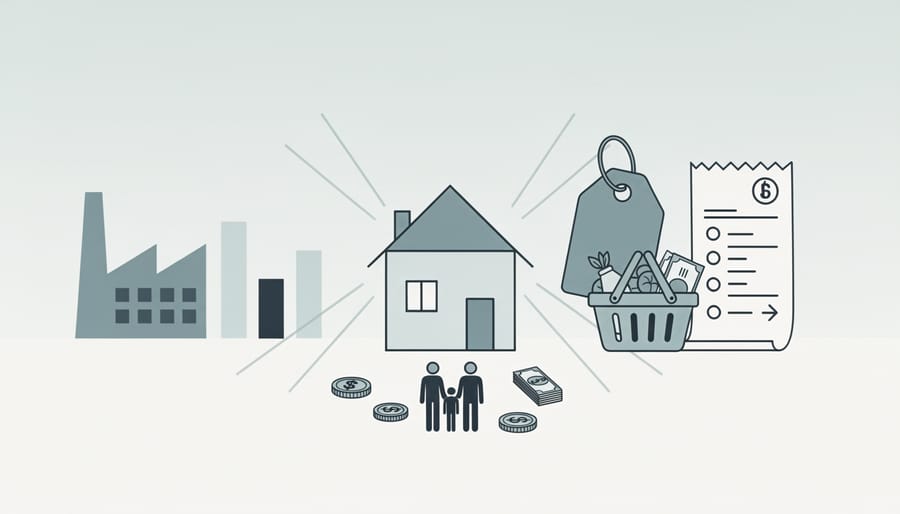
Inflation, Jobs, and Spare Capacity
Inflation has been running hotter than policymakers expected. The Bank of Canada’s October 2026 report puts it at around 3% through much of 2027, with a return to roughly 2% by the middle of 2028, as laid out in the Inflation path in 2027 and 2028 outlook. That’s a slow glide back to target, and households will feel the gap in the meantime.
The jobs picture explains part of why price pressure sits alongside a soft economy. The July 2026 report notes that the unemployment rate had generally fluctuated between 6½% and 7%. Unemployment signals excess supply meaning there’s slack in the labour market and unused capacity across the economy. In plain terms, more workers are available than the economy is currently putting to use.
That slack is also a source of opportunity. Spare capacity means room to grow without immediately overheating, provided investment picks up and productivity improves. Sectors that pair new hiring with emerging energy technology and broader technology adoption are the ones best placed to turn idle capacity into higher output per worker.
How Canada’s Economic Progression Is Shaping Key Industries

Energy and Mining: Capital, Projects, and Trade Diversification
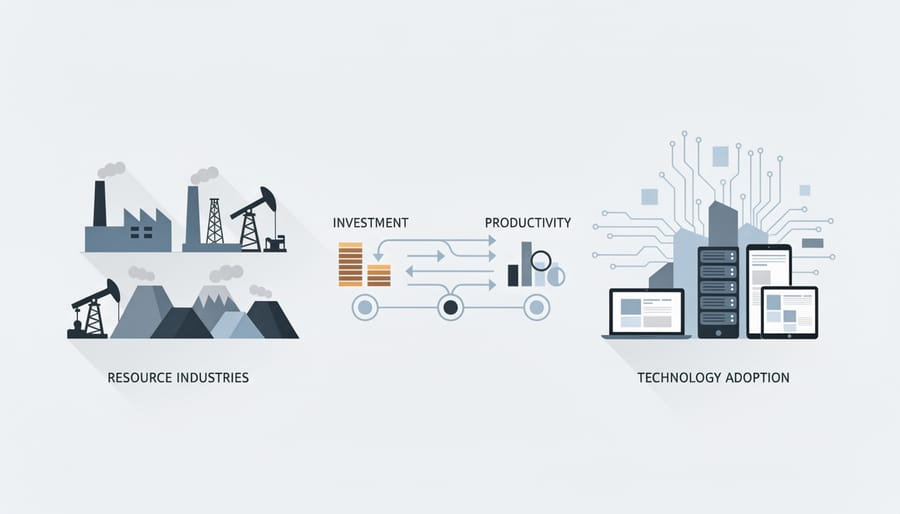
Resource industries sit close to the centre of the government’s stated economic agenda. Since spring 2025, Ottawa says it has worked to accelerate major projects, attract capital, and diversify economic relationships. For energy and mining, those three priorities map directly onto the sector’s biggest constraints: long project timelines, heavy upfront investment, and dependence on a few export markets.
Capital is the common thread. Budget 2026 describes lagging private sector investment as a defining weakness of the past decade, and resource projects are capital-intensive by nature. Faster approvals could shorten the gap between a proposal and a shovel in the ground, which matters when financing costs and market conditions can shift during a long review. Investors tend to reward certainty, so a more predictable path from application to construction is, in principle, an opening for the sector.
Trade diversification works in a similar way. The Bank of Canada continues to describe an economy adjusting to US tariffs and a new global trade landscape. For producers of oil, gas, minerals, and metals, reaching more buyers reduces exposure to any single market’s policy swings.
Partnerships will shape how this unfolds. Many major projects depend on early, meaningful engagement with communities, and the growth of the Indigenous economy is a good example of how ownership and participation can strengthen both project delivery and regional prosperity.
Technology and Innovation: Closing the Productivity Gap
Productivity is the one lever that can raise living standards without relying on population growth, and technology sits close to its centre. Budget 2026 points to weak productivity growth and lagging private sector investment as the defining features of the past decade. Read differently, that gap is also a measure of how much room there is to improve.
Here’s the logic. A worker with better tools, whether automation, data analytics, or smarter software, produces more in the same hour. But those tools have to be bought, adopted, and learned, which takes private sector capital. When firms hold back on investment, the productivity gains they might have captured never arrive. That is why attracting capital, a stated government priority since spring 2025, matters for technology as much as for any resource project.
For professionals and educators, the practical takeaway is skills. Technology only lifts output when people can use it well, so training in digital and data capabilities becomes part of the productivity story. For students, it signals where demand for talent is likely to build.
The Bank of Canada expects growth to stay modest while the economy adjusts to US tariffs. In that setting, firms that invest in efficiency now are positioning themselves for the recovery rather than waiting for it. Closing the productivity gap won’t happen overnight, but it is one of the clearest routes from today’s challenges to stronger long-term growth.
What Policy Is Doing: Government Priorities and Who Is Affected
Since taking office in spring 2025, the federal government says it has focused on four moves: accelerating major projects, strengthening trade within Canada, attracting capital, and diversifying economic relationships. Each one targets a problem Budget 2026 names directly. Over much of the past decade, the budget says, Canada has seen weak productivity growth, lagging private sector investment, and intensified affordability pressures.
The table below connects each priority to the issue it aims to address and the groups most likely to feel its effects. It reflects the stated direction of policy, not specific programs or outcomes.
| Policy priority | What it aims to address | Groups most likely affected |
|---|---|---|
| Accelerating major projects | Lagging private sector investment and slow project delivery | Employers, workers in project-linked industries, investors |
| Strengthening trade within Canada | Weak productivity growth and fragmented internal markets | Businesses operating across provinces, consumers |
| Attracting capital | Investment shortfalls that hold back output per worker | Investors, employers, workers in expanding sectors |
| Diversifying economic relationships | Exposure to US tariffs and a shifting global trade landscape | Exporters, manufacturers, households facing price pressures |
Who is affected depends on where you sit. Workers feel the results through job availability and wage growth. Employers feel them through investment conditions and market access. Households feel them mostly through affordability, and with the Bank of Canada projecting inflation around 3% through much of 2027, that pressure is unlikely to ease overnight. Investors watch how policy shapes returns and project pipelines.
Engaging with government programs comes with both rights and obligations. You generally have the right to clear information about what a program offers and how decisions are made. You are also expected to provide accurate information, meet reporting requirements, and respect program terms. Eligibility usually turns on factors like business size, sector, location, or personal circumstances, but criteria vary widely from one program to the next. Always confirm the current requirements with the official source before you plan around them.
Where to Get Help and Reliable Information
Staying informed matters as much as understanding the issues, and the best sources are the official ones. For professionals, educators, and students, a handful of reliable places can turn broad headlines into practical insight.
- Bank of Canada Monetary Policy Reports: Official outlooks on growth, inflation, and unemployment, published several times a year.
- Federal budget documents: Detailed policy direction, including the government’s stated priorities on productivity, investment, and trade.
- Statistics Canada: Independent data on jobs, prices, and output that lets you check claims against the numbers.
- Government of Canada business and employment services: Federal guidance for employers, job seekers, and workers navigating a changing labour market.
- Provincial and regional economic development agencies: Local support, networks, and information tied to your region’s industries.
A simple habit goes a long way. Read the summary of each new Monetary Policy Report, then compare it with the latest Statistics Canada releases. You’ll quickly learn where the official outlook and the real data line up, and where they don’t.
Educators can bring these primary sources straight into the classroom, and students can use them to ground research in verified facts. Program details and eligibility change, so always confirm specifics with the relevant government office or agency before making decisions. Treating these sources as a regular part of your routine keeps you ahead of the trends shaping your sector.
Frequently Asked Questions About Canada’s Economy
Why does Canada’s economy remain weak?
Budget 2026 points to weak productivity growth, lagging private sector investment, and intensified affordability pressures over much of the past decade. It also notes that growth leaned heavily on population increases rather than gains in output per worker.
How is Canada adjusting to US tariffs?
The Bank of Canada says the economy is adjusting to US tariffs and a new global trade landscape, with growth expected at a modest to moderate pace. The government says it has also worked to strengthen trade within Canada and diversify economic relationships since spring 2025.
Is the economy showing signs of improvement?
The Bank of Canada’s July 2026 report describes an economy that has been weak but is showing signs of improvement. Unemployment had generally fluctuated between 6½% and 7%, which points to spare capacity rather than a fully stretched labour market.
When is inflation expected to return to target?
The Bank of Canada’s October 2026 report says inflation has been higher than anticipated and is projected to stay around 3% through much of 2027. It expects inflation to return close to 2% by the middle of 2028.
These answers share a common thread: the problems are measurable, and official forecasts give a timeline for recovery. Tracking the next Monetary Policy Report is the simplest way to see whether the improvement the Bank describes is taking hold in your sector.
Canada’s economic challenges are real, but they are also well defined, and that is good news. Weak productivity growth, lagging private sector investment and affordability pressures are specific problems with specific levers. Growth that leaned on population rather than output per worker points to where the next gains must come from: better tools, smarter capital and stronger trade ties.
The near-term picture supports a measured optimism. The Bank of Canada has described an economy that was weak but showing signs of improvement, still adjusting to US tariffs and a new global trade landscape, with inflation expected to ease back toward 2% by mid-2028. Slack in the labour market means there is room to grow without overheating.
That is the heart of Canada’s economic progression and its industry impact. Whether you work in energy, mining, technology or education, the shifts ahead will reward people who prepare for them. Follow the Bank of Canada’s Monetary Policy Reports, federal budget documents and Statistics Canada releases, then ask what each one means for your own sector. Problems this clearly drawn can be solved, and the professionals who understand them best will be the ones who help solve them.