
Indigenous economy represents a distinctive framework where economic development interweaves cultural preservation, collective stewardship, and community sovereignty. Unlike conventional growth models that prioritize individual profit maximization and resource extraction, Indigenous economic systems center long-term sustainability, intergenerational responsibility, and the wellbeing of both people and land. This approach has gained substantial traction across Canada as Indigenous communities assert greater control over development on their territories, reshaping sectors from renewable energy to natural resource management while generating billions in annual economic activity.
The distinction matters because Indigenous economies operate on fundamentally different principles. Where mainstream models measure success through GDP growth and shareholder returns, Indigenous frameworks evaluate prosperity through community health, language revitalization, environmental stewardship, and self-determination. These aren’t abstract ideals. They translate into concrete business practices: seven-generation planning horizons, benefit-sharing agreements that distribute wealth across entire nations, and development decisions guided by traditional knowledge alongside market analysis.
Canada’s economic landscape is transforming as Indigenous communities become major players in energy infrastructure, forestry, fisheries, and mining. By 2026, Indigenous businesses contribute over $30 billion annually to the national economy, while Indigenous-led partnerships control significant stakes in resource projects from coast to coast. This shift reflects both legal recognition through court decisions affirming rights and title, and growing acknowledgment that sustainable development requires Indigenous expertise and consent.
Understanding Indigenous economy means recognizing it as neither a niche topic nor a historical artifact, but rather a forward-looking model offering solutions to challenges that conventional economics has struggled to address: climate adaptation, resource depletion, and community resilience. The sector-specific applications and policy frameworks shaping this evolution reveal pathways toward economic reconciliation that benefit all Canadians.
Defining the Indigenous Economy Framework
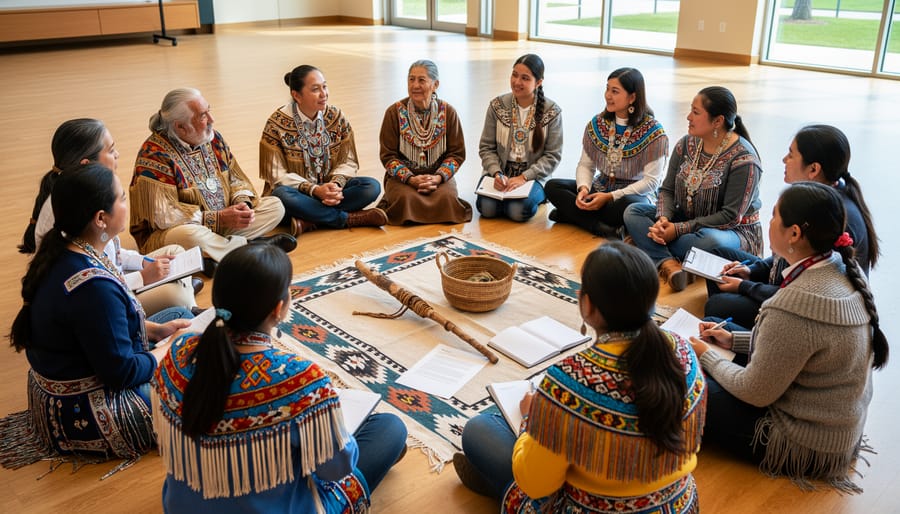
An indigenous economy operates on fundamentally different principles than conventional market systems. Rather than prioritizing individual profit maximization or quarterly returns, these economic frameworks centre community wellbeing, ecological sustainability, and cultural continuity across generations. Indigenous economies are self-determined systems where communities exercise sovereignty over their resources, lands, and economic futures according to their own governance structures and values.
The distinction matters. Mainstream extractive economies typically separate economic activity from environmental stewardship and cultural practice, treating natural resources as commodities to exploit for maximum short-term gain. Indigenous economic models reject this fragmentation. They integrate land management, resource use, cultural preservation, and community development as interconnected elements of a single system. A forestry operation isn’t just about timber revenue; it encompasses habitat protection, traditional harvesting rights, cultural site preservation, youth employment, and ensuring future generations inherit healthy forests.
Several core principles define this framework. Collective ownership means profits and decision-making authority belong to the community rather than individual shareholders. Resource stewardship replaces extraction, operating on the understanding that communities depend on healthy ecosystems indefinitely. Intergenerational wealth thinking extends planning horizons beyond typical business cycles, asking how decisions today will affect descendants seven generations forward.
Crucially, Indigenous economies don’t reject modern enterprise or technology. Communities operate sophisticated corporations, invest in renewable energy infrastructure, and participate in global supply chains. The difference lies in governance and purpose. An Indigenous-owned solar company might prioritize training community members, protecting sacred sites during construction, and reinvesting profits in education and cultural programs alongside financial returns.
These aren’t abstract ideals. From British Columbia to Nunavut, Indigenous communities are building economies that generate revenue, create employment, and maintain cultural identity simultaneously. They demonstrate that economic development and environmental protection aren’t opposing forces but mutually reinforcing goals when structured around Indigenous governance principles and long-term community benefit rather than short-term extraction.
Historical Context and Policy Evolution
Before colonization, Indigenous peoples across what is now Canada operated sophisticated economic systems built on trade networks spanning thousands of kilometers, sustainable resource harvesting, and governance structures that managed complex economies without written property law. These systems supported millions of people through fishing, agriculture, hunting, and trade, economies intricately tied to land stewardship and seasonal cycles.
Colonial economic policies systematically dismantled these systems. The Indian Act of 1876 imposed restrictions that prevented Indigenous peoples from selling agricultural products, accessing capital, or participating in the broader Canadian economy without government permission. Reserve lands, often unsuitable for agriculture or resource extraction, isolated communities from economic opportunities. Pass systems restricted movement. Children forcibly removed to residential schools lost connection to land-based economic knowledge. By the mid-20th century, most Indigenous communities faced severe poverty while resources extracted from traditional territories enriched others.
The legal foundation for change began emerging through court decisions recognizing Aboriginal rights. The 1973 Calder case, though technically unsuccessful, prompted the federal government to acknowledge unextinguished Aboriginal title and establish a land claims process. Section 35 of the 1982 Constitution Act recognized and affirmed Aboriginal and treaty rights, creating constitutional protection that courts have since interpreted to include economic dimensions.
The 1990s brought accelerated policy shifts. The Delgamuukw decision (1997) confirmed that Aboriginal title includes the right to economic benefits from traditional lands. Modern treaties and comprehensive land claim agreements, like Nunavut (1993) and the Nisga’a Final Agreement (1998), transferred land, resources, and capital to Indigenous governments. Impact benefit agreements became standard in major resource projects, requiring consultation and revenue sharing.
By the 2010s, the discourse shifted from consultation toward partnership. Free, prior and informed consent gained policy traction. Indigenous communities became equity partners in pipelines, co-developers of renewable energy projects, and co-managers of protected areas. The Truth and Reconciliation Commission’s Calls to Action (2015) explicitly linked reconciliation with economic self-determination. Today’s framework increasingly recognizes Indigenous economic sovereignty as essential to both reconciliation and Canada’s sustainable prosperity.
Current Indigenous Economic Models in Practice
Energy Sector Leadership
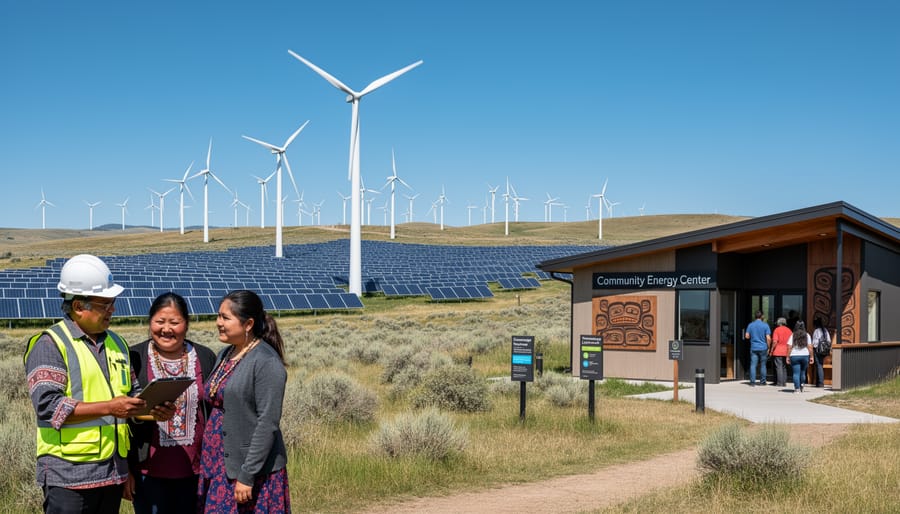
Indigenous communities are reshaping Canada’s energy future through ownership stakes and governance roles that would have seemed impossible a generation ago. The Lukowich First Nation in northern Saskatchewan now operates a 10-megawatt solar farm as sole owner, feeding power directly into the provincial grid and generating revenue that funds education and housing. T’Sou-ke Nation on Vancouver Island built Canada’s first solar-powered First Nation, cutting its energy costs by 75% while selling surplus electricity, a model replicated by dozens of communities since.
This shift from consultation targets to project co-developers marks a fundamental change in power dynamics. Indigenous communities now hold equity positions in major wind farms across Alberta and Ontario, participate as full partners in hydroelectric expansions in British Columbia and Manitoba, and negotiate revenue-sharing agreements that deliver long-term financial streams rather than one-time impact payments. The renewables shift aligns naturally with Indigenous priorities: distributed generation fits remote community needs, renewable projects avoid the long-term environmental liabilities of extraction, and ownership structures can be designed around collective benefit rather than shareholder returns.
Current Indigenous energy economic models include:
- Equity partnerships where communities hold 25-50% ownership in commercial wind and solar developments
- Community power corporations operating as independent utilities serving on-reserve and regional customers
- Impact benefit agreements providing employment guarantees, skills training, and percentage-based revenue shares
- Independent power producer projects wholly owned by Indigenous nations selling to provincial grids
Even in traditional energy sectors, relationships are evolving. Several Alberta First Nations have acquired ownership stakes in pipeline companies and natural gas processing facilities, using the cashflow to fund renewable transitions. This pragmatic approach, extracting value from existing fossil infrastructure while building clean alternatives, reflects the reality that energy transition happens in stages, not overnight.
Natural Resource Management and Guardianship Programs
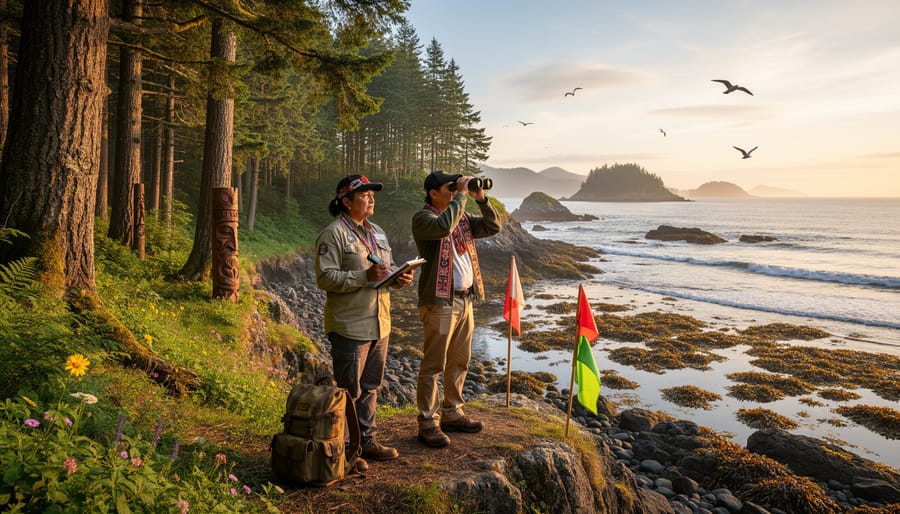
Indigenous Protected and Conserved Areas represent a convergence of economic opportunity and ecological responsibility that’s redefining resource management across Canada. IPCAs, landscapes where Indigenous communities hold decision-making authority, now cover over 14% of Canada’s land and freshwater, creating direct employment in conservation, research, and tourism while maintaining ecosystem services worth billions annually. Unlike conventional protected areas, IPCAs integrate cultural practices like sustainable harvesting and ceremonial use, ensuring traditional economies continue within conservation frameworks.
Guardian programs sit at the heart of this model. Communities employ members in Indigenous Guardians roles that blend environmental monitoring with traditional ecological knowledge, tracking wildlife populations, documenting climate impacts, managing visitor access, and responding to environmental threats. The Coastal Guardian Watchmen Network in British Columbia, for instance, employs over 70 people across remote communities, generating income while protecting marine ecosystems from illegal fishing and oil spill risks. These aren’t token positions; they’re year-round careers requiring technical training in GIS mapping, water quality testing, and species identification alongside Indigenous knowledge transmission.
Sustainable forestry operations managed by First Nations are proving economically competitive while maintaining forest health. The Tla’amin Nation’s forestry corporation in BC generates $8 million annually through selective harvesting that prioritizes long-term yield over short-term extraction. Similarly, Indigenous fisheries on both coasts are adopting selective harvesting techniques and co-management agreements that stabilize fish stocks while securing fishing rights worth tens of millions.
This stewardship economy creates jobs that keep people on the land, strengthens food security through traditional harvesting, and delivers measurable environmental outcomes, cleaner water, healthier wildlife populations, intact carbon sinks, that benefit all Canadians downstream.
Indigenous Business and Social Enterprise
Indigenous-owned businesses have expanded dramatically across Canada’s economy, moving well beyond resource extraction into construction, professional services, technology, tourism, and creative industries. This diversification reflects both growing entrepreneurial capacity and structural shifts that enable Indigenous participation in mainstream markets while maintaining community connections.
Construction and infrastructure sectors have seen particularly strong Indigenous business growth, driven by major projects requiring Indigenous partnerships and skilled trades development. Professional services, including legal, accounting, consulting, and engineering firms, increasingly operate under Indigenous ownership, serving both Indigenous and non-Indigenous clients while bringing culturally informed perspectives to complex projects.
The technology sector represents emerging strength, with Indigenous entrepreneurs launching software companies, digital agencies, and tech startups that address everything from language preservation apps to specialized resource management platforms. Tourism operations blend cultural education with economic opportunity, creating employment in communities while sharing Indigenous knowledge and experiences with visitors.
Indigenous financial institutions and business development corporations provide crucial infrastructure for this growth. Organizations like the National Aboriginal Capital Corporations Association network offer financing, mentoring, and capacity building that conventional lenders often cannot provide. These institutions understand community contexts and long-term economic visions that prioritize collective benefit alongside individual success.
Social enterprises occupy particularly important space in Indigenous economies, deliberately blending profit generation with community purpose, whether employing at-risk youth, funding cultural programs, or supporting elders. This model aligns naturally with Indigenous values of collective responsibility.
Procurement policies have accelerated Indigenous business expansion significantly. Federal requirements for Indigenous participation in government contracts, along with corporate supply chain diversity initiatives, create market access that helps Indigenous businesses scale while maintaining community ownership and values-based operations.
Traditional Economy and Cultural Industries
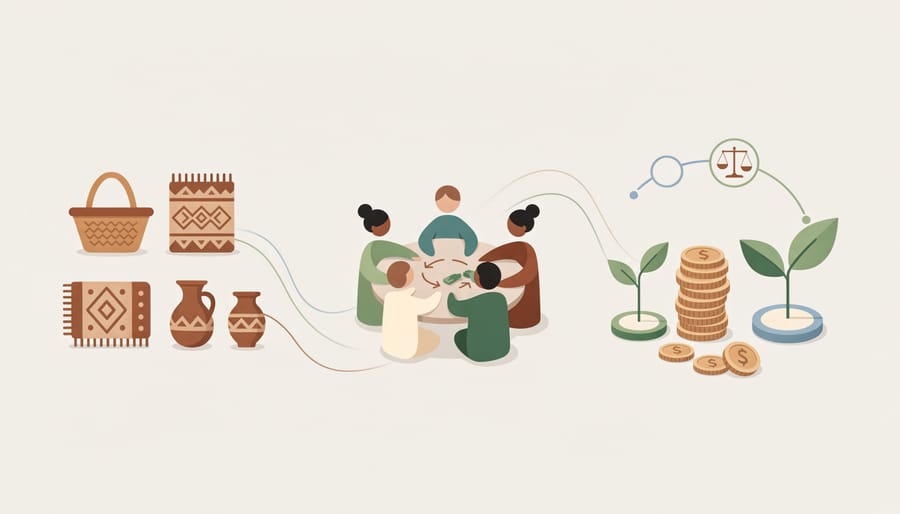
Traditional harvesting of fish, game, and plants remains foundational to many Indigenous economies, generating both subsistence value and commercial income through treaty-protected rights. Communities operate commercial fisheries, wild game processing, and traditional food enterprises that supply local markets while preserving land-based knowledge systems passed between generations.
Cultural tourism has emerged as a significant revenue source, with Indigenous-operated lodges, guided expeditions, and interpretive centres offering authentic experiences that share stories, ceremonies, and traditional practices. These ventures create employment in remote regions while controlling how Indigenous cultures are represented to visitors.
The arts sector, from Haida argillite carving to Inuit printmaking and Métis beadwork, contributes hundreds of millions annually to Canada’s economy. Indigenous artists increasingly retain copyright control and sell directly through cooperatives and online platforms, capturing more value while maintaining artistic integrity.
Language revitalization programs, though primarily cultural initiatives, generate economic activity through teaching positions, curriculum development, and language technology projects. Communities recognize that preserving Indigenous languages strengthens cultural identity, which in turn supports the transmission of traditional ecological knowledge essential to sustainable resource management and land-based economies that distinguish Indigenous economic models from extractive alternatives.
Economic Impact and Measurement Challenges
Quantifying the indigenous economy presents a paradox: Indigenous economic activity is simultaneously undervalued by conventional measures and increasingly significant to Canada’s economic future. Current estimates place Indigenous business contributions at over $30 billion annually to Canada’s GDP, with Indigenous-owned businesses growing at rates exceeding the national average. Yet these figures capture only a fraction of the true economic picture.
The limitation stems from how we measure economic value. Standard GDP accounting emphasizes market transactions and cash flow, systematically excluding or undervaluing the substantial economic activity rooted in traditional practices. When a community harvests traditional foods, operates a Guardian program that prevents ecological damage worth millions, or maintains cultural knowledge systems that inform sustainable resource management, conventional metrics register these contributions poorly or not at all. A fisheries Guardian preventing habitat degradation creates measurable economic value, avoided costs, sustained fish stocks, maintained tourism revenue, but national accounts rarely capture it.
Recognizing this gap, economists and Indigenous organizations are developing alternative frameworks that integrate multiple value streams:
| Measurement Dimension | Conventional Metric | Indigenous-Centered Indicator |
|---|---|---|
| Economic Output | GDP contribution from market transactions | Total economic value including traditional harvesting, ecosystem services, cultural production |
| Employment | Formal employment rates and wages | Productive activity including land-based work, cultural transmission, community roles |
| Resource Value | Extraction revenue and royalties | Long-term ecosystem health, sustained yield capacity, intergenerational resource access |
| Community Wellbeing | Income levels and poverty rates | Food security, language vitality, cultural continuity, self-determination measures |
These holistic frameworks reveal what standard metrics miss. When British Columbia’s Coastal First Nations measured their Guardian Watchmen programs, they documented not just employment numbers but quantified benefits: reduced illegal harvesting, improved wildlife monitoring, enhanced emergency response capacity, and strengthened cultural connections to territory. The economic value exceeded program costs several times over, yet appeared minimally in provincial GDP figures.
Looking toward 2026 and beyond, the indigenous economy’s measured impact will grow as both Indigenous economic activity expands and measurement methods improve. Indigenous-led major projects in renewable energy, sustainable forestry operations, and technology ventures are entering mainstream economic statistics. Simultaneously, economists are integrating environmental accounting and wellbeing indicators that better reflect Indigenous economic contributions. This dual shift promises a more accurate picture of how Indigenous economies strengthen regional resilience, create employment in rural areas often lacking alternatives, and model economic approaches that maintain rather than deplete natural capital.
Future Trajectories: 2026 and Beyond
The trajectory of Indigenous economies points toward expanded self-determination across multiple sectors that will reshape Canada’s economic landscape. Several converging forces are accelerating this shift: legal recognition of jurisdiction strengthening, capital access improving, and non-Indigenous institutions increasingly recognizing that Indigenous governance models offer practical solutions to sustainability challenges affecting everyone.
Resource jurisdiction represents the most significant near-term expansion. As treaty implementations advance and self-government agreements mature, more Indigenous nations are moving from consultation participants to regulatory authorities with direct control over permitting, environmental standards, and resource extraction terms on their territories. This shift fundamentally alters project economics and timelines, requiring industry to adapt to Indigenous legal frameworks rather than merely seeking approval within provincial systems. By 2030, expect Indigenous regulatory bodies to govern substantial portions of Canada’s resource base, particularly in northern regions where their jurisdiction is already established.
Climate policy and conservation finance are emerging as areas where Indigenous leadership is becoming indispensable. Guardian programs and Indigenous Protected and Conserved Areas demonstrate measurable environmental outcomes that attract international conservation investment. As carbon markets mature and nature-based climate solutions gain traction, Indigenous communities controlling vast landscapes are positioned to access significant revenue streams from carbon sequestration, biodiversity credits, and ecological restoration projects. These mechanisms align with traditional stewardship practices while generating capital that reduces dependence on extractive industries.
The technology sector presents opportunities that bypass traditional barriers to economic participation. Indigenous communities are developing data sovereignty frameworks that assert control over information generated on their lands, from environmental monitoring to genetic resources. Some nations are establishing digital infrastructure, data centres powered by renewable energy, technology training programs, and software development companies, that participate in energy emerging technology and clean energy innovation while creating employment that keeps younger generations connected to their communities.
Cross-sector partnerships are evolving beyond procurement set-asides toward genuine equity arrangements. Major infrastructure projects increasingly include Indigenous ownership stakes from inception, not as afterthoughts. Urban development is beginning to incorporate Indigenous design principles and economic participation as future cities grapple with sustainability and reconciliation simultaneously.
The broader influence may prove most transformative. Indigenous economic models prioritizing intergenerational wealth over quarterly returns, measuring success through community wellbeing alongside financial metrics, and integrating ecological limits into development decisions offer blueprints for a post-growth economics that Canada will need as climate constraints tighten and resource depletion accelerates.
Frequently Asked Questions About Indigenous Economy
What exactly is the indigenous economy?
The indigenous economy refers to economic systems built on Indigenous governance, collective ownership, and land stewardship principles rather than purely market-driven models. It encompasses both traditional activities like harvesting and cultural practices alongside modern enterprises in energy, technology, and resource management, all grounded in community benefit and intergenerational thinking.
How do Indigenous communities balance economic development with environmental protection?
Indigenous economic models typically integrate environmental stewardship as a core principle rather than treating it as separate from development. Communities apply traditional ecological knowledge to resource management, prioritize long-term sustainability over short-term extraction, and often structure projects around protecting land and water for future generations, seeing economic and environmental health as interdependent.
What legal frameworks enable Indigenous economic development?
Section 35 of Canada’s Constitution recognizes and affirms Aboriginal and treaty rights, providing the legal foundation for Indigenous resource rights and self-governance. Modern treaties, land claim agreements, and the United Nations Declaration on the Rights of Indigenous Peoples further establish Indigenous authority over traditional territories and economic decision-making.
How can non-Indigenous businesses engage ethically with Indigenous economies?
Ethical engagement requires moving beyond consultation to genuine partnership, seek free, prior, and informed consent, structure deals that provide equity ownership and decision-making power to Indigenous communities, respect Indigenous governance processes, and commit to long-term relationships rather than transactional agreements. Procurement from Indigenous-owned businesses and supporting Indigenous financial institutions also strengthens economic participation.
These questions reflect the most common knowledge gaps non-Indigenous Canadians face when encountering Indigenous economic development. The distinction between consultation and consent matters significantly in practice. Companies that understand Indigenous communities as rights-holders and economic partners, not stakeholders to manage, build more durable, mutually beneficial relationships.
Economic reconciliation extends beyond addressing historical wrongs to actively creating space for Indigenous economic self-determination today. That means recognizing Indigenous jurisdiction, supporting capacity building, and accepting that Indigenous communities may choose development paths that prioritize different values than conventional return-on-investment calculations. For Canada’s economy to genuinely include Indigenous participation, the rules themselves need to accommodate Indigenous governance structures and long-term stewardship approaches rather than forcing Indigenous communities into frameworks designed without them.
The indigenous economy is no longer an alternative model on the periphery, it has become central to how Canada will navigate its economic future. As Indigenous communities reclaim economic self-determination, they are demonstrating that prosperity and sustainability can coexist, that resource development can honour both land and people, and that traditional knowledge holds practical solutions to modern challenges.
Supporting Indigenous economic development isn’t a charitable gesture or a reconciliation checkbox. It’s a strategic imperative. Indigenous-led energy projects are accelerating Canada’s clean energy transition. Guardian programs are protecting ecosystems that underpin regional economies. Indigenous businesses are filling critical gaps in infrastructure, services, and innovation. These contributions ripple outward, strengthening supply chains, creating employment beyond reserve boundaries, and modeling governance approaches that balance profit with long-term stewardship.
The path forward requires genuine partnership, not performative consultation. It means respecting Indigenous jurisdiction over traditional territories, ensuring equitable access to capital and procurement opportunities, and recognizing that Indigenous economic success strengthens the entire Canadian economy. When Indigenous communities control their resources and economic futures, they build wealth that stays in communities for generations rather than extracting it for short-term gain.
Canada’s economic resilience in 2026 and beyond will depend partly on how fully we embrace Indigenous economic leadership. The transformative potential is already visible in communities across the country, now it’s time to scale it, support it, and learn from it.